


Learn how to pack and move wall art, framed pictures, mirrors, and hanging décor safely. Step-by-step guide from the team at 2 Jacked Guyz professional movers.
Figuring out how to pack and move wall art and mirrors is one of those moving challenges that people consistently underestimate — until they are standing in front of a large oil painting wrapped loosely in a garbage bag, or trying to figure out how to keep a six-foot ornate mirror from flexing and cracking in the back of a moving truck. Wall art, framed photographs, canvas prints, hanging mirrors, sculptural wall pieces, and decorative clocks all share one frustrating quality: they are almost never the right shape for a standard box, they are frequently irreplaceable, and the margin for error is very small. One bad bounce on a rough road, one corner that was not padded well enough, one frame stacked directly against a heavy box — and something you have lived with for years is gone.
The good news is that packing and moving wall décor — even large, oddly shaped, or genuinely valuable pieces — is completely manageable when you approach it with the right materials, the right sequence, and a real understanding of what each type of piece needs. And if you would rather hand the heavy lifting to professionals who know how to handle everything from a framed family portrait to a full-length beveled mirror, the team at 2 Jacked Guyz professional movers is ready to take it from overwhelming to done.
Before you remove a single nail or pull a single frame off its hook, walk through every room in your home and take a thorough look at everything hanging on your walls. This inventory step feels like extra work when you are already juggling the hundred other tasks that come with a move — but it is the single most important thing you can do to protect your pieces and simplify the packing process.
As you go, ask yourself honest questions about each item. Is this piece genuinely valuable — financially, sentimentally, or both? Is the frame original or high quality? Is the glass standard or specialty (like museum glass or UV-filtering acrylic)? Is the piece large enough that it needs a custom solution rather than a standard mirror box? Has anything already been damaged — a cracked frame corner, a small chip in a mirror, a canvas with an existing dent — that you should document before it moves?
That last point matters more than most people realize. Documenting existing damage with photos before packing protects you in the event that something is disputed after the move. It also helps you prioritize: pieces that are already fragile or partially damaged need extra care in packing, and some may not be worth moving at all in their current state.
Use this walkthrough to sort your pieces into categories: small framed items that can share a box, medium framed pieces that each need individual wrapping, large framed or canvas pieces that need custom boxes or specialty crating, and mirrors — which are in a category of their own when it comes to packing risk.
The right materials make an enormous difference when it comes to wall art. Using the wrong padding — or skipping steps because you ran out of supplies — is one of the most common reasons framed pieces and mirrors arrive damaged. Before you start packing, gather everything you need so you are not making compromises mid-job.
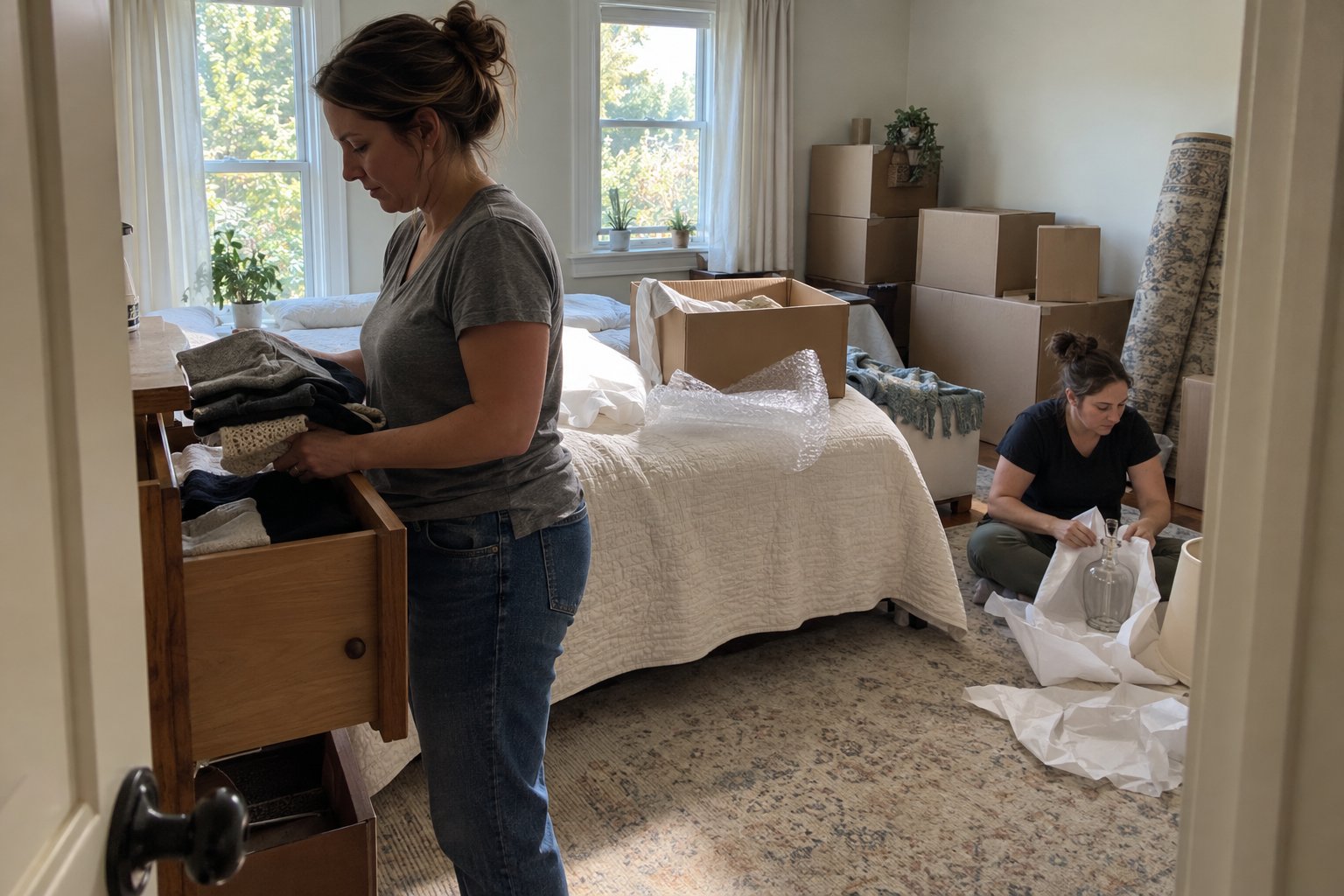
Packing paper (unprinted newsprint) is your baseline wrapping material for frames. It is soft enough not to scratch finishes and easy to mold around corners and irregular shapes. Bubble wrap is your secondary layer — use it over the packing paper for any piece with glass, any piece with a delicate frame finish, and any canvas that has texture you want to protect. Small bubble wrap (the kind with smaller bubbles) is actually better than large bubble for fragile frames because it conforms more precisely and creates more consistent cushioning.
Foam corner protectors are essential for framed pieces. Frame corners are the most vulnerable point in any move — they are where impact damage almost always happens — and a proper foam corner protector that fits snugly over each corner will protect the frame and the glass inside it. Cardboard corner guards are a reasonable alternative if foam protectors are not available.
Mirror boxes — telescoping flat boxes specifically designed for mirrors and large framed art — are worth buying or sourcing rather than trying to improvise. They are sized and reinforced for the purpose and make transport significantly safer. For very large mirrors or high-value pieces, specialty art crates or wooden crating may be appropriate.
Painter's tape (blue masking tape) has one specific and important job: applying an X pattern across the face of a mirror before packing. If the mirror breaks in transit despite proper packing, the tape keeps the shards together and dramatically reduces the risk of injury during unpacking. It peels off cleanly without damaging the mirror surface.
Framed pieces — whether they hold oil paintings, photographs, prints, or needlework — all follow the same basic packing logic, with adjustments based on size, glass type, and frame fragility.
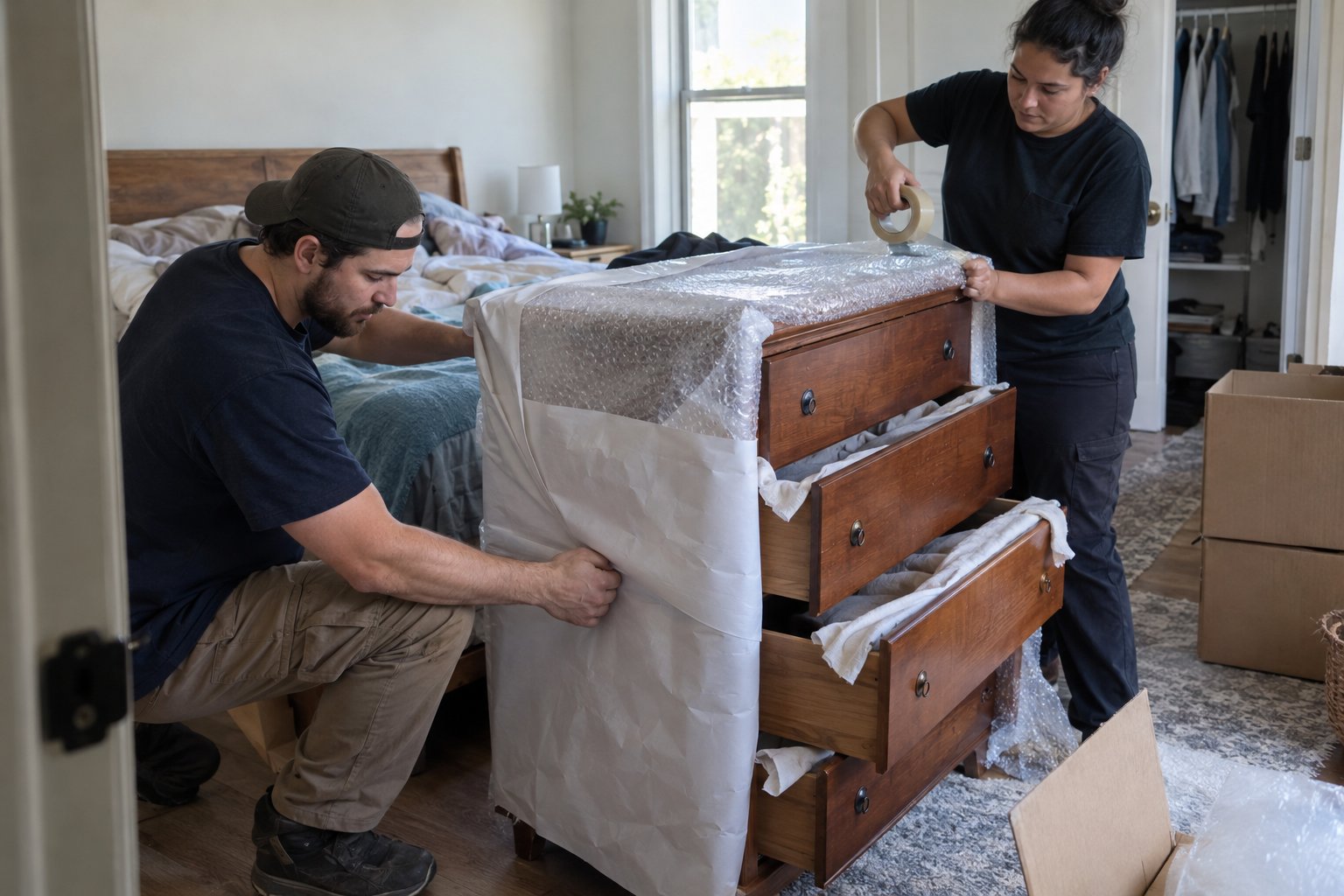
Start by placing foam corner protectors on all four corners of the frame. If you do not have foam protectors, cut small squares of cardboard and tape them over each corner instead. Once the corners are protected, lay a large sheet of packing paper flat on a surface, place the frame face-down in the center, and fold the paper around it as you would wrap a gift — bringing the sides in first, then folding the top and bottom over and securing with packing tape. The frame should be snug inside the paper with no loose gaps at the corners.
For any frame with glass — standard glass, acrylic, or museum glass — add a layer of bubble wrap around the paper-wrapped frame. Secure it with tape without letting tape touch the frame surface directly. Glass-covered frames should always be transported with the glass face parallel to the wall of the truck, never flat on the bottom of a stack where weight from above can push directly into the glass.
If a frame is particularly large or an original artwork with no glass, consider adding a sheet of glassine paper (an acid-free, non-stick paper used in art handling) between the frame and the wrapping material to protect the surface from any friction or moisture during the move.
Small and medium framed pieces can be grouped in a single box if they are individually wrapped and separated by cardboard dividers or additional crumpled packing paper. Never put glass face against glass face — always keep wrapped pieces separated. Load framed art in boxes on edge (standing upright), never flat, and fill any empty space in the box with crumpled packing paper so nothing shifts during transit. Mark the box "Fragile — Art — This Side Up" clearly on at least three sides.
Larger framed pieces should go in their own mirror box or be packed in a custom-sized box. When sizing a box, you want roughly two to three inches of padding space on every side of the wrapped piece.
Mirrors are among the most challenging items to move safely, and they deserve their own section because the consequences of getting it wrong are serious — a broken mirror is both a safety hazard and, in many cases, an irreplaceable loss.
Before you do anything else, apply painter's tape in a large X pattern across the entire face of the mirror from corner to corner, then add additional strips of tape in a grid pattern across the surface. This does not prevent the mirror from breaking — it keeps the pieces together if it does break, which protects you and anyone else who handles the box later.
After taping, apply foam corner protectors to all four corners. Wrap the entire mirror in a layer of packing paper, followed by a layer of bubble wrap, securing with tape at the back. For large mirrors, two people are needed for this step — do not try to wrap a large mirror alone.
Place the wrapped mirror in a mirror box sized to fit with two to three inches of padding on all sides. If the mirror does not fill the box completely, pack the gaps with crumpled packing paper or foam so there is no movement inside the box. Seal the box, reinforce all seams with packing tape, and mark it "Fragile — Mirror — Do Not Lay Flat" on all four sides and the top.
In the truck, mirrors should travel upright — standing on their long edge, not lying flat — leaned against the truck wall and secured so they cannot tip or slide. Never stack anything on top of a mirror box.
Not everything on your walls fits neatly into the framed art or mirror category. Decorative wall clocks, dimensional wall sculptures, large canvas prints without frames, woven wall hangings, and oversized art pieces all require tailored approaches.
Remove any batteries before packing a clock to prevent corrosion or leakage during the move. If the clock has a glass cover, tape it with painter's tape in the same X pattern used for mirrors. Remove pendulums, clock hands, or any hanging elements that can shift and break during transport, wrap them separately, and keep them in a labeled bag taped to the inside of the clock box. Clocks with chime mechanisms or intricate internal works should be packed with minimal movement — wedge the interior components with foam or tissue paper if the clock is mechanical, or consult the manufacturer's guidance if available.
Large canvas prints that are stretched on a wooden frame but have no glass covering are both more durable and more vulnerable than you might expect — durable because there is no glass to shatter, but vulnerable because the canvas surface itself can be punctured, dented, or abraded by contact with other items. Wrap these pieces in glassine paper first (to protect the painted or printed surface), then in bubble wrap, and transport them upright. Never stack anything against the canvas face.
For original paintings of significant value, professional art crating is worth the investment. A wooden crate built around the piece provides impact protection that no cardboard box can match, and for long-distance moves or anything genuinely irreplaceable, it is the standard professional approach.
Woven wall hangings, tapestries, and textile art pieces should be rolled rather than folded whenever possible — folding creates creases that can be very difficult to remove. Roll the piece loosely around a cardboard tube (the kind that comes inside wrapping paper works well), wrap the rolled piece in acid-free tissue paper or clean cotton fabric, and box or bag it separately. Keep textile pieces away from anything sharp, heavy, or liquid.
Whatever is hanging on your walls, the right materials and a methodical approach will get it to your new home safely. And when the job feels like more than you want to take on alone, the team at 2 Jacked Guyz professional movers has the experience and the supplies to handle your wall décor — and everything else in the house — with the care it deserves.
Request a personalized quote and see how careful planning and reliable service make every move smoother. Our team prepares each step to handle challenges safely and efficiently.
Specialty mirror boxes — the flat, telescoping kind designed for mirrors and large framed art — are strongly recommended over regular moving boxes. They are reinforced for the purpose, sized to minimize movement inside the box, and significantly reduce the risk of breakage. Regular boxes can work for small framed pieces but are not ideal for mirrors, which need the extra structural support and a snug, cushioned fit.
No. Wall art and mirrors should come down and be properly packed well before moving day — ideally one to two days before. Leaving them on the walls until the last minute creates rushed packing, which is when corners get skipped and damage happens. Taking them down early also gives you time to patch and clean the walls before you leave.
Yes, and it is one of the most important steps. Painter's tape applied in an X pattern across the mirror face does not prevent the mirror from breaking, but if it does break during the move, the tape holds the shards together. This dramatically reduces the risk of injury when the box is handled and unpacked, and it can also keep a cracked mirror in one piece long enough to assess whether it can be repaired.
You can pack multiple small to medium framed pieces in the same box, provided each piece is individually wrapped in packing paper and bubble wrap, foam corner protectors are in place on all frames, and cardboard dividers or crumpled packing paper separate each piece so they cannot contact each other in transit. Always load framed pieces on edge — standing upright — never flat in the box.
For large original artworks or pieces of significant financial or sentimental value, professional art crating is the safest option. A custom wooden crate built around the piece provides impact protection no cardboard box can match. If you are moving long distance or have genuine concern about a specific piece, discuss it with your moving team in advance — professional movers with experience handling high-value items can advise on the right approach for your specific piece.
No long forms, no delays. Just a move that’s ready when you are. Secure your moving date today.